
Publications
Computational Reproducibility and Robustness of Empirical Economics and Political Science Research Between 2022 and 2023
(with Abel Brodeur, Derek Mikola, Nikolai Cook et al.)
Nature 652, 151-156, 2026
(with Abel Brodeur, Derek Mikola, Nikolai Cook et al.)
Nature 652, 151-156, 2026
Economic Impacts of China’s Zero-COVID Policies
(with Zhuocheng Shang, Yaqin Su, Andong Yan and Qi Zhang)
China Economic Review, Volume 83, 2024, 102101
(with Zhuocheng Shang, Yaqin Su, Andong Yan and Qi Zhang)
China Economic Review, Volume 83, 2024, 102101
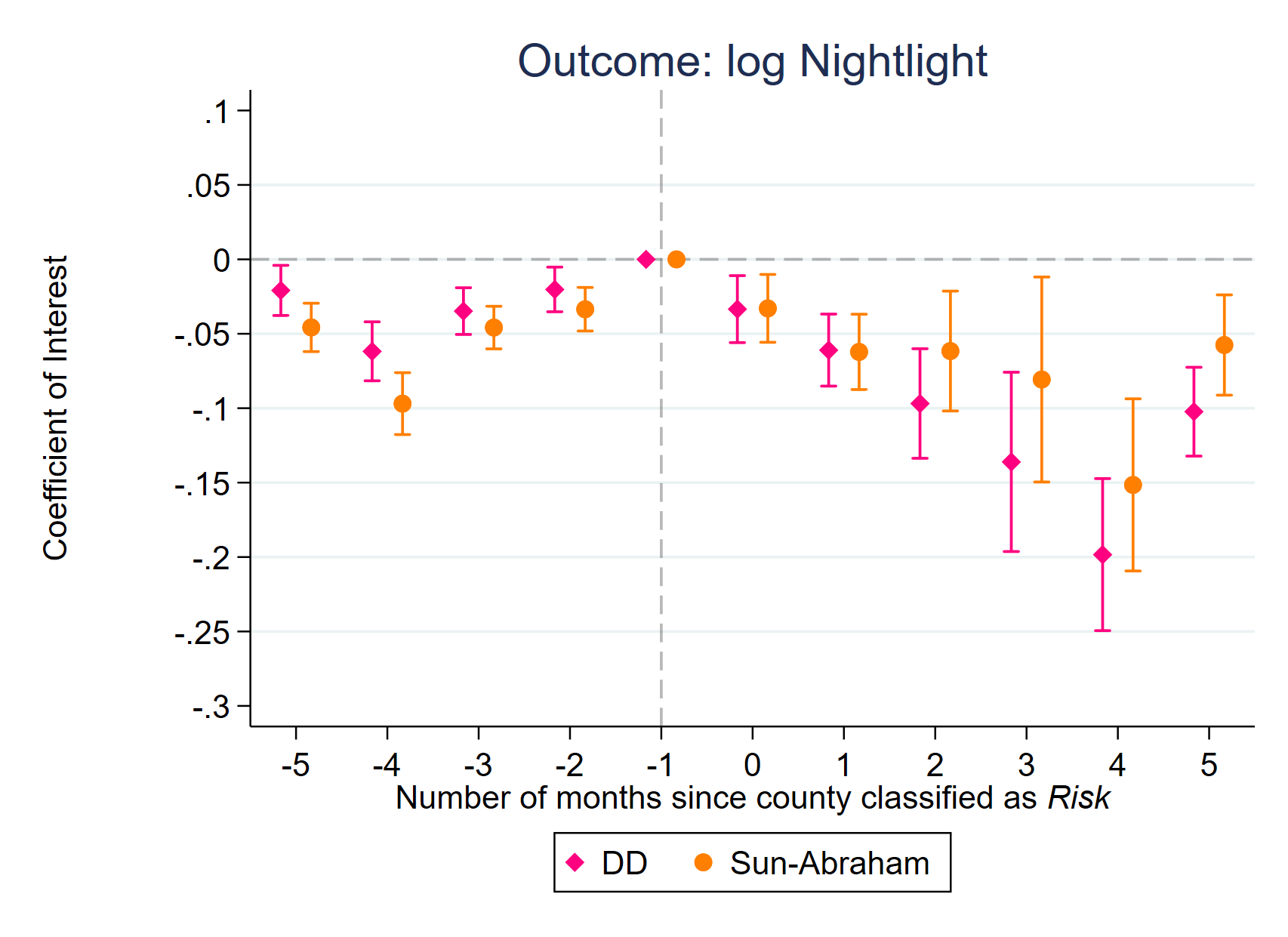
In this paper, we offer the first comprehensive examination of the economic impacts of China's zero-COVID policy. To achieve this, we utilize an original panel dataset that includes county-level data on daily COVID risk levels.
[Manuscript] [China COVID Risk Level Dataset]
Abstract
This paper presents an investigation of the economic consequences of the zero-COVID policy implemented by the Chinese government as a pilot experiment in using big data for country management from 2020 to 2022. Our study includes an original county-daily panel data set on the COVID-19 Risk Level issued by the State Council of the People’s Republic of China (PRC). To measure economic activities, we used satellite data on night lights and PM2.5, and geographical data on population mobility. Our findings indicate that the zero-COVID policy did not result in significant economic loss in 2021. However, in 2022, when the Omicron variant emerged, a stricter zero-COVID policy led to a 30% decline in mobility, a 1.17% decrease in PM2.5 and a 7.7% reduction in night lights. Based on our calculations, China experienced a 3.9% loss in GDP as a consequence of the implementation of the zero-COVID policy in 2022.
Cost of Zero-Covid: Effects of Anti-contagious Policy on Labor Market Outcomes in China
(with Andong Yan and Jialin Yu)
Journal of Labor Research, Volume 45, 2024
Nomination For The Best Paper Award, 1st International Workshop on the Chinese Development Model , 2022
(with Andong Yan and Jialin Yu)
Journal of Labor Research, Volume 45, 2024
Nomination For The Best Paper Award, 1st International Workshop on the Chinese Development Model , 2022
The Impacts of the Zero-Covid Policy on Academic Performance: Evidence for Primary and Secondary Students in China
(with Yaqin Su, Anping Xia, and Andong Yan)
Journal of Asian Economics, Volume 93, 2024, 101762
(with Yaqin Su, Anping Xia, and Andong Yan)
Journal of Asian Economics, Volume 93, 2024, 101762
Working Papers
House of the Rising Sun: Strategically Loyal Republicans and Prisoner’s-Dilemma Democrats
(with Andong Yan, Cantay Caliskan, Ezgi Siir Kibris and Eunseong Oh)
(with Andong Yan, Cantay Caliskan, Ezgi Siir Kibris and Eunseong Oh)
The Imagined Congress: What Generative AI Models Think U.S. Politicians Look Like
(with Cantay Caliskan, Ezgi Siir Kibris and Andong Yan)
(with Cantay Caliskan, Ezgi Siir Kibris and Andong Yan)

In this paper, we examine how three generative AI models represent U.S. politicians when demographic and political information is withheld. Using a masked-prompt experiment with 88,155 AI-generated portraits of 509 members of Congress, we compare the models’ inferred age, gender, and race signals with legislators’ verified characteristics.
[Manuscript]
Abstract
How do generative AI models imagine political elites when key information is missing? We answer this question with a large scale evaluation of AI generated portraits of the U.S. Congress. We generate 88,155 headshots of 509 legislators from DALL•E 3, Stable Diffusion, and Adobe Firefly using prompts that systematically mask age, gender, race, ideology, or legislative experience, and we compare the demographic signals in these portraits to each legislator's verified characteristics using a common computer vision pipeline. Under the full information prompt, AI portraits already diverge sharply from reality: on average, generated politicians appear 26.3 years younger than the legislators they represent, shift 0.172 points toward male on a binary gender measure, and shift 0.156 points toward nonwhite on a binary race measure. These distortions are not randomly distributed. Party heterogeneity is strongest for age in absolute comparisons, with Republicans rendered older than Democrats, while the clearest gender distortion is a disproportionate masculinization of women under masked prompts. Ideology heterogeneity is most consistent for gender and, to a lesser extent, race, but largely disappears for age in within politician comparisons. Tenure matters primarily for age, and in the opposite direction from our initial expectation: longer serving politicians are rendered younger, not older, when information is withheld. Across platforms, more safety curated systems often produce larger incremental distortions than Stable Diffusion, especially for true women on gender and true white politicians on race. To summarize, the findings show that generative AI does not merely reproduce political faces. It consistently reconstructs them in ways that carry implications for representation, campaign imagery, platform governance, and democratic accountability.
Double Trouble: A Benchmark of Debiasing and Bounding Methods for Downstream Inference with AI Annotations
(with Jue Yao)
(with Jue Yao)
Come As You Are? Strategic Congressional Multimodal Partisan Signaling in U.S. Legislators
(with Eunseong Oh, Seda Gunes, Sachidhananthar Abidhananthar, Saya Kondo, Eva Mandell and Elijah Woods)
(with Eunseong Oh, Seda Gunes, Sachidhananthar Abidhananthar, Saya Kondo, Eva Mandell and Elijah Woods)
Formation and Evolution of Beliefs: Famine Experience and Trust in Neighbors
(with Zhian Hu and Chuanchuan Zhang)
(with Zhian Hu and Chuanchuan Zhang)
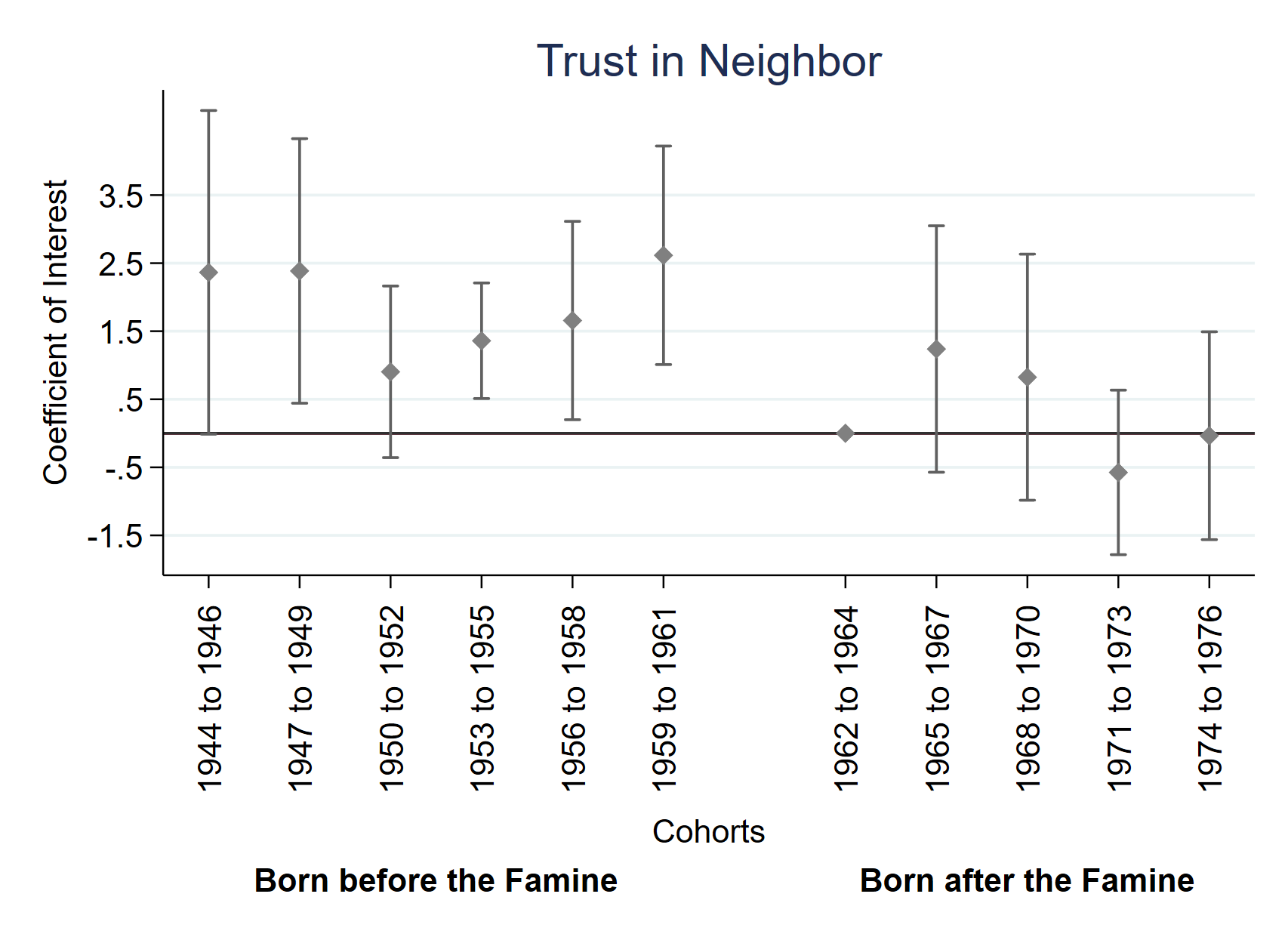
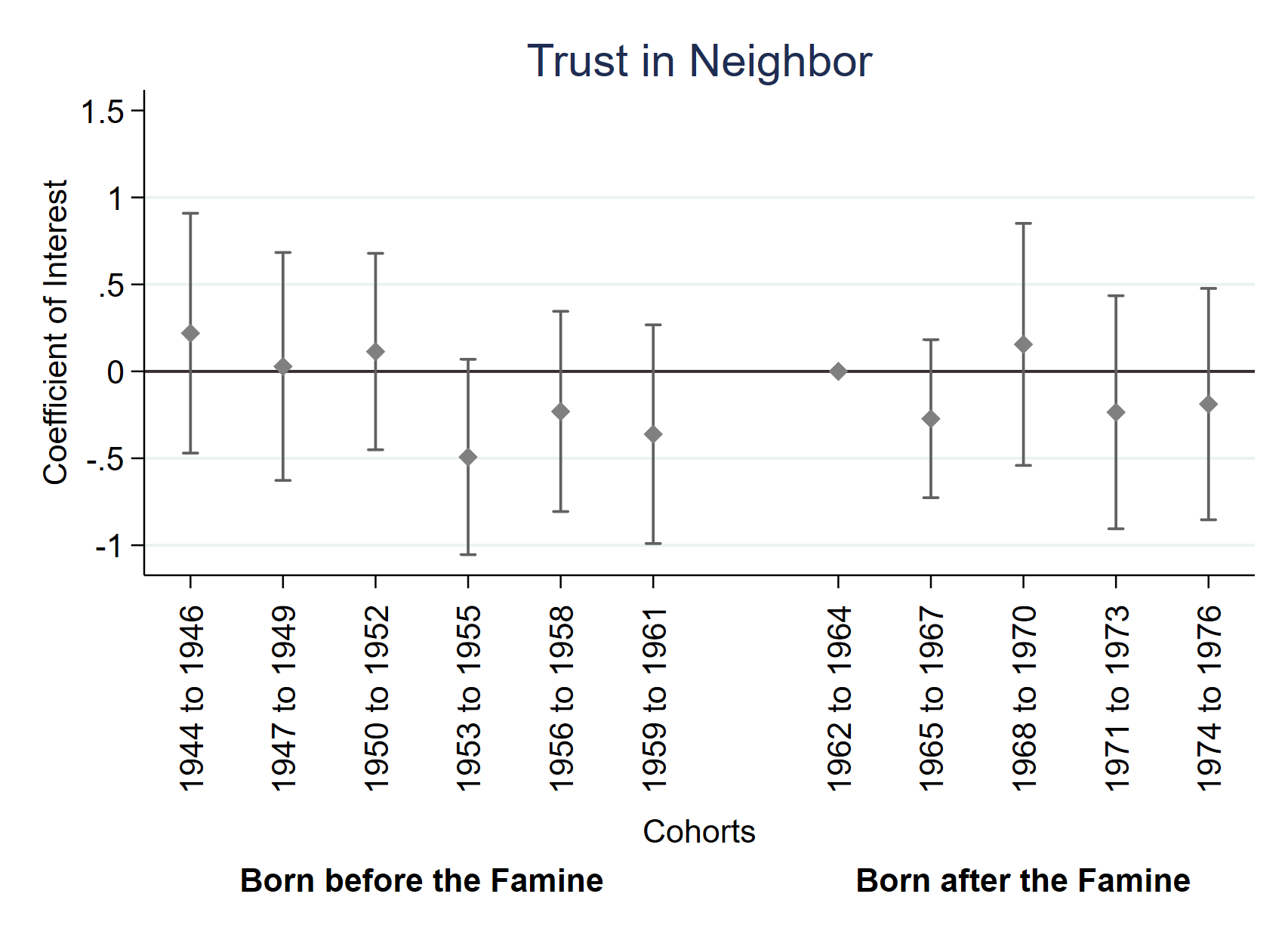
This paper examines how the impact of traumatic experiences on contemporary trust could vary across different initial social capital levels.
[Manuscript]
Abstract
This paper examines how the impact of traumatic experiences on contemporary trust could vary across different initial social capital levels within the context of the Confucian clan and the Great Chinese Famine. Our triple-differences analysis exploit county-level variation in famine intensity, variation in famine exposure based on birth cohorts, and geographic variation in the initial clan culture. We use soil suitability to instrument for famine intensity. We find that traumatic experiences strengthen trust among clan members in areas with high levels of initial social capital. Our findings are robust to model choice and pass placebo tests, and remain stable in a event study model.
The Half-Life of Incentive Distortion: Evidence from a Natural Experiment in Crisis
(with Andong Yan)
(with Andong Yan)
Other Publications & Technical Reports
Market Integration and North-South Differences in the Late Qing Dynasty: Insights from Silver-Copper Cash Exchange Rates
(with Weipeng Yuan)
Qing History Journal. 2025,(01), in Chinese
(with Weipeng Yuan)
Qing History Journal. 2025,(01), in Chinese
Replication Report: A Comment on Gethin, Martínez- Toledano & Piketty (2022)
(with Olle Hammar ) I4R Discussion Paper 19, 2023
(with Olle Hammar ) I4R Discussion Paper 19, 2023
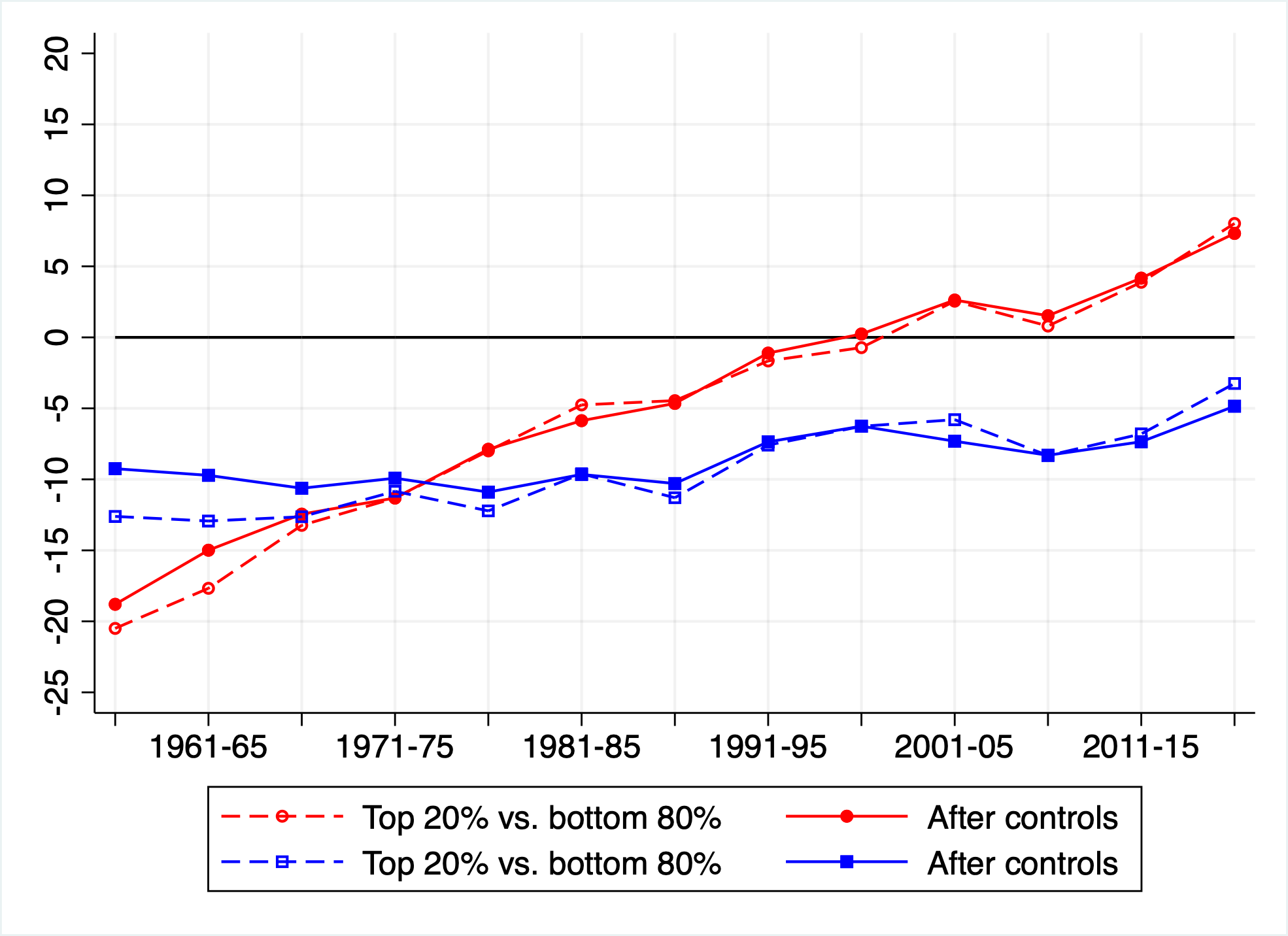
This is a replication report of Gethin, Martínez- Toledano & Piketty (2022) .
[Manuscript] [Data & Code]
Abstract
Gethin, Martínez-Toledano and Piketty (2022) analyze the long-run evolution of political cleavages using a new database on socioeconomic determinants of voting from approximately 300 elections in 21 Western democracies between 1948 and 2020. They find that, in the 1950s and 1960s, voting for the “left” was associated with lower-educated and low-income voters. After that, voting for the “left” has gradually become associated with higher-educated voters, while high-income voters have continued to vote for the “right”. In the 2010s, there is a disconnection between the effects of income and education on voting. In this replication, we first conduct a computational reproduction, using the replication package provided by the authors. Second, we do a robustness replication testing to what extent the original results are robust to i) restricting the sample to “core” left and right parties, ii) analyzing the top 80% versus bottom 20%, iii) weighting by population, iv) dropping control variables, and v) using country fixed effects. The main results of the paper are found to be largely replicable and robust.
Currency Usage in Huizhou Region Before and After Taiping Rebellion: Evidence from Account Books
(with Weipeng Yuan ) Jianghai Academic Journal .2023,(01) , in Chinese
(with Weipeng Yuan ) Jianghai Academic Journal .2023,(01) , in Chinese
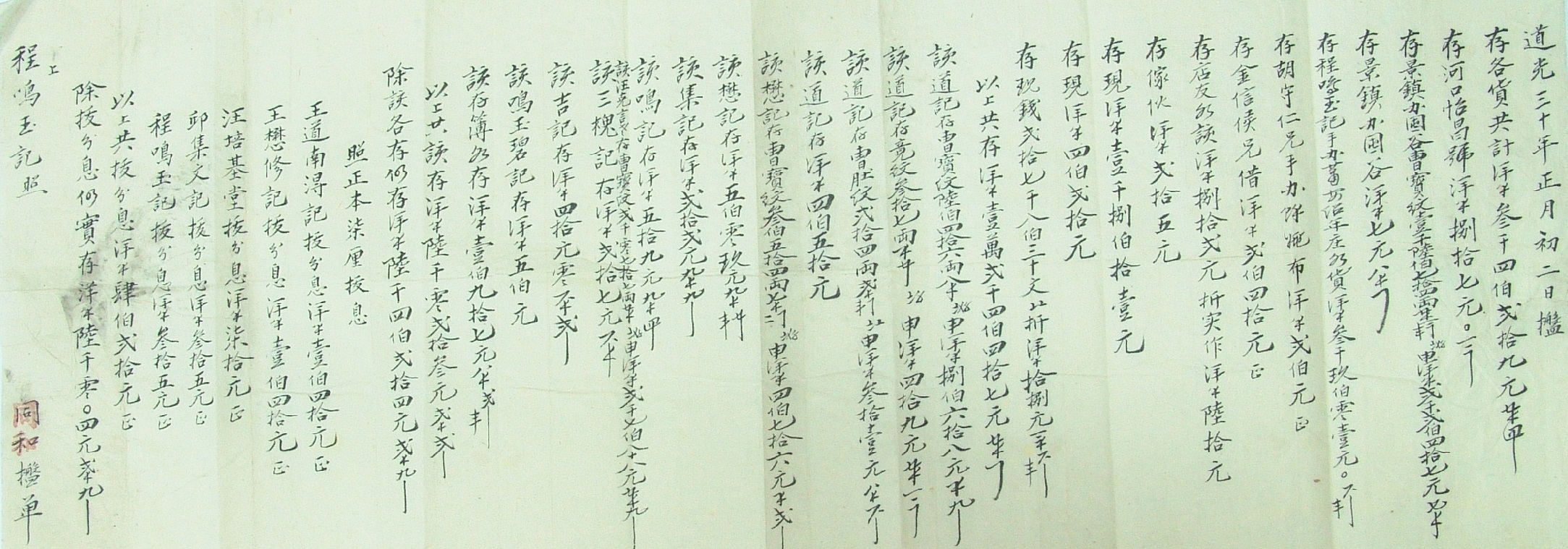
By using currency usage data collected from 19 century account book, we find that Taiping Rebellion had a significant impact on the regional economy. However, the usage of foreign silver dollar in Huizhou area rebounded rapidly after the war.
[Manuscript]
Work in Progress
AI Visual Persuasion and Policy Accountability
(with Andrea Ciccarone and Mengmeng Wu)
(with Andrea Ciccarone and Mengmeng Wu)
Causal Inference with Representation-Defined Treatments
(with Yongjai Yu)
(with Yongjai Yu)
Small Business Resilience and the COVID-19 Pandemic
(with Qingfang Wang and Wei Kang)
(with Qingfang Wang and Wei Kang)
The Effects of Broadening the Tax Base on Education
(with Ugo Antonio Troiano)
(with Ugo Antonio Troiano)
A Multimodal Analysis of Authoritarian Media Framing: Domestic vs. International Media
(with Mengmeng Wu and Seda Gunes)
(with Mengmeng Wu and Seda Gunes)
Air Pollution and Corporate Political Contributions
(with Fan Li and Li Lu)
(with Fan Li and Li Lu)
"Sleep, that knits up the ravelled sleeve of care. The death of each day's life, sore labour's bath. Balm of hurt minds, chief nourisher in life's great feast... Sleep's the one thing left to us. The one thing they couldn't get their filthy mitts on. Now, they're even grabbing that. Colonising it."
--- Sleep No More (Doctor Who: Season 9, Episode 9)
Governor Press Release Effects on Public Beliefs and Behaviors During a Pandemic
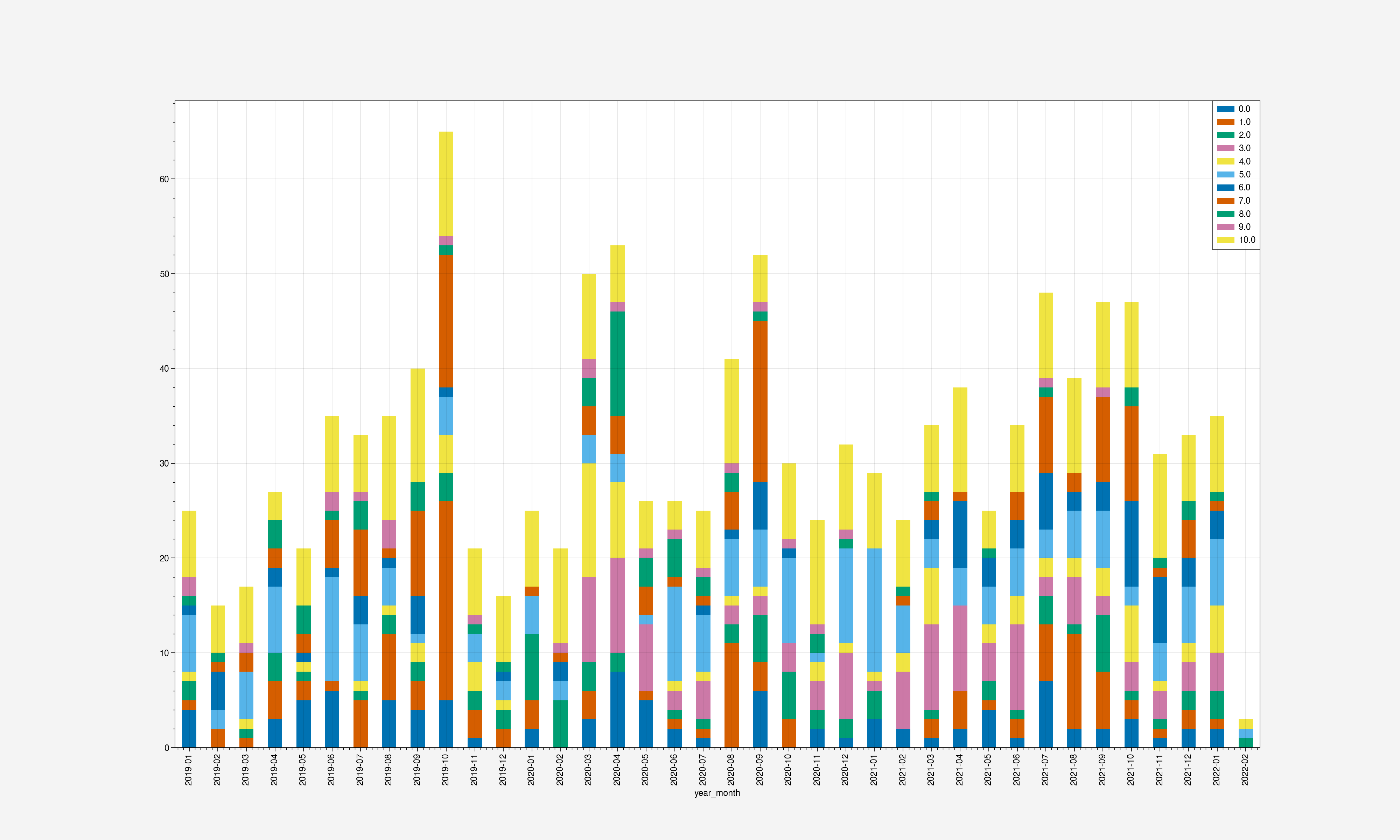
Abstract
This research focuses on how politician’s opinions, provided by local media, shape people’s belief and behavior related to COVID. Specifically, how state governors’ press release (analyzed by natural language processing), covered by local media, impact on people’s social distancing response, belief in conspiracy theory and trust in COVID vaccines. I use geographic variations, specifcally the difference between media market boundaries and state boundaries, as quasi-random exposures to local news and politicians’ press releases. My approach involves collecting data on governors’ press releases and employing Natural Language Processing models such as Topic LDA and COVID-Bert to categorize news topics and measure politicians’ attitudes towards COVID and related policies. Additionally, I leverage multiple waves of survey data from MIT, CMU, and Facebook, providing outcome variables such as individuals’ social distancing behavior, mask usage, and vaccine intent.